
The Ficus benjamina often loses its leaves after repotting in a significant number of cases, and the cause is almost never just the substrate. What determines the success of the operation is the sequence of actions and their timing. Repotting at the wrong time, pruning simultaneously, or changing the watering routine can trigger cumulative stress from which the plant takes weeks to recover. This article measures the impact of each variable to isolate what really matters.
Post-repotting stress of Ficus benjamina: the influencing factors
Repotting causes root shock, the intensity of which depends on several simultaneous parameters. Care guides published in 2026 emphasize a principle often overlooked: do not water, move, and repot at the same time. Each isolated intervention is manageable, but their combination exceeds the plant’s ability to adapt.
The table below compares the relative effect of three common actions taken immediately after repotting.
| Action combined with repotting | Risk of leaf drop | Recovery time |
|---|---|---|
| Change of location | High | Several weeks |
| Structural pruning | Very high | Several months |
| Change in watering rhythm | Moderate to high | Several weeks |
| Repotting alone (same location, same watering) | Low to moderate | Less than two weeks |
The last line of the table summarizes the safest approach. Successfully repotting Ficus benjamina relies less on the technique itself than on the ability to change nothing else during the root recovery phase.
An often-overlooked detail: the proximity of a bowl of ripe fruit exacerbates leaf drop. The ethylene released by the fruit accelerates leaf abscission, especially when the plant is already weakened by transplantation.
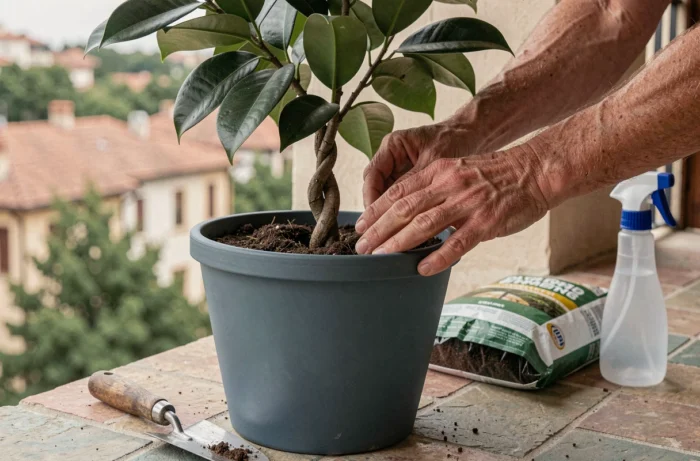
Pruning and repotting Ficus: why separate these two interventions
Pruning a Ficus benjamina just after repotting seems logical (taking advantage of the opportunity), but it is the riskiest combination. Gardening advice articles published in August 2026 detail the mechanism: after repotting, the plant concentrates its resources on root regeneration. Removing leaf mass at this stage deprives the Ficus of its photosynthetic capacity at the very moment it needs it most.
Formative pruning is safer when the plant shows signs of active growth, such as new buds and visible shoot elongation. This signal indicates that the root system is functioning properly and that the plant has an energy surplus.
Recommended sequence for a growing Ficus
- Repot first, then wait for new shoots to appear before any pruning (count on several weeks minimum).
- Do not move the pot during root recovery, even to optimize light: Ficus benjamina reacts to changes in orientation with leaf drop.
- Postpone fertilization for at least two to three weeks after repotting, allowing time for the roots to heal and explore the new substrate.
On the other hand, removing a dead branch or a visibly declining shoot is possible at any time: this type of sanitary pruning does not tax the plant’s reserves.
Substrate and drainage for repotting an indoor Ficus
The choice of substrate determines the speed of recovery. Ficus benjamina tolerates a range of mixes, but two criteria dominate: rapid drainage and moderate moisture retention. A substrate that is too compact keeps the roots in a saturated environment that promotes rot, especially in the weeks following repotting when the plant absorbs less water.
A potting mix for green plants supplemented with perlite or pumice (about one quarter of the volume) offers a good compromise. The layer of clay pebbles at the bottom of the pot, often recommended, does not actually improve drainage if the drainage hole is insufficient. It is better to ensure that the pot has at least one adequately sized opening.

Pot size: a measured gap
Moving to a container that is too large compared to the root ball is a common mistake. A pot with an additional two to three centimeters in diameter is sufficient. An excessive volume of substrate around the roots remains wet for too long, which slows root colonization and increases the risk of suffocation.
Conversely, a pot that is barely larger forces a new repotting within a short time. A gap of two to three centimeters remains the best compromise between growth space and management of residual moisture.
Ideal timing and signs of necessary repotting for Ficus benjamina
The spring vegetative recovery period (March-May) remains the most favorable window. The plant enters an active growth phase, allowing it to quickly rebuild its root network. Repotting in autumn or winter, when metabolism slows down, significantly extends recovery time.
Several signs indicate that a Ficus needs a new pot:
- Roots that emerge from the drainage hole or form a dense mat on the surface of the substrate.
- A substrate that dries abnormally quickly after watering, a sign that the root ball occupies almost all the available volume.
- Slowed growth despite adequate light and nutrient supply.
- Yellowing of the lower leaves without identifiable cause (pests, drafts, excess water).
The average rhythm is around one repotting every two to three years for an indoor Ficus benjamina. Young, rapidly growing specimens may require a higher frequency.
The Ficus benjamina forgives many maintenance mistakes, but not the accumulation of simultaneous stresses. Separating each intervention over time, respecting the spring window, and resisting the urge to correct everything in one session remains the most reliable method to maintain dense foliage after repotting.