Women’s creativity is no longer limited to a catalog of craft techniques sorted by difficulty level. For several seasons now, the creative landscape for women has been reconfigured around hybrid formats that blend manual practice, social engagement, and personal expression. Understanding these changes allows us to identify truly promising trends, far from decorative lists that merely stack disciplines.
Creative Women’s Evenings: A Hybrid Format Between Workshop and Activism
Creative events exclusively for women are experiencing a clear acceleration. In Montpellier, local media document the rise of evenings combining DIY workshops, performances, and sports activities, presented as an explicit lever to deconstruct clichés about femininity and the body.
We observe that this model goes beyond mere leisure. The creative workshop becomes a space of sisterhood, where manual production serves as a pretext for conversation, sharing experiences, and reclaiming free time often fragmented by mental load.
What distinguishes these formats from traditional workshops is the absence of a commercial purpose. No pieces for sale, no results to showcase on social media. The process takes precedence over the finished product, and it is precisely this positioning that attracts an audience weary of the pressure for creative performance. The organizers mapping these initiatives, as seen on the Elle Imagine website, cover a wide spectrum ranging from fashion to decoration to personal development.
Pinterest Creative Trends: Kitchen Witch, Handmade Hacker, and the Return of Making
The macro-trends identified by Pinterest for the current season outline a very different creative profile from what traditional fairs offer. Four movements structure the female creative universe:
- Kitchen Witch: intuitive cooking, home herbalism, making candles and homemade cosmetics. The home becomes a laboratory for sensory experimentation.
- Backyard Botanist: herbariums, plant dyes, dried floral arrangements. Nearby nature (garden, balcony, park) provides the raw materials and inspiration.
- Handmade Hacker: repurposing industrial materials, textile upcycling, customizing everyday objects. Technique matters less than the boldness of the gesture.
- Secondhand Sidequest: thrift shopping, transforming vintage clothing, creating unique pieces from finds. Style comes from recovery.
The common denominator of these four currents can be summed up in one sentence: to produce something tangible with one’s hands, away from screens. Digital platforms serve as showcases and tutorials, but the value lies in the physical object and the time invested.
TikTok and DIY Virality: What Digital Changes in Creative Techniques
The role of TikTok in spreading creative trends deserves a technical reading. The platform does not merely popularize existing disciplines. It reformats techniques to make them compatible with a short video format.
Quilling, for example, is experiencing a resurgence of interest documented by regional media after viral demonstrations. But TikTok quilling is not traditional quilling: the patterns are simplified, the papers pre-cut, and the final result must be photogenic in less than thirty seconds of viewing.
Virality selects techniques that film well, not necessarily those that provide the most manual satisfaction. We recommend clearly distinguishing digital inspiration (discovering a discipline via an algorithm) from actual practice (investment in time, materials, and learning).
This distinction explains why some trends explode online and then fade within weeks, while others, less spectacular on video (cross-stitch embroidery, Japanese bookbinding), maintain a stable and engaged community.
Fashion, Decoration, and Art: Creative Boundaries Are Blurring
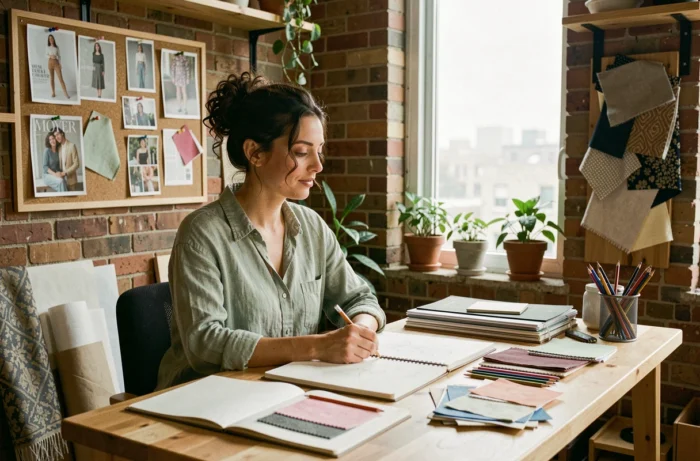
A striking feature of current women’s creativity is the rejection of rigid categories. A single creator may work with textiles for clothing, use the same plant dye for a wall decoration piece, and document the process in a watercolor-illustrated notebook.
This porosity between fashion, art, and decoration is not a communication effect. It reflects an approach where personal style unifies all productions, whether they are worn, displayed, or gifted. Creative magazines that still segment their sections by discipline miss this reality.
For industry professionals, the consequence is direct: cross-disciplinary supply ranges (natural pigments usable in both painting and textile dyeing, papers compatible with watercolor and collage) generate more engagement than mono-disciplinary ranges.
Tips for Building a Coherent Creative Universe
Building a personal creative universe is not about accumulating techniques. The classic trap, reinforced by the overload of inspiration on social media, is to start five disciplines simultaneously without deepening any.
Three guidelines help structure a sustainable practice:
- Choose a base material (paper, textile, clay) and explore its variations for several months before adding another.
- Document your work in a physical format (notebook, wall moodboard) rather than exclusively digital, to anchor progress in the tangible.
- Prioritize regularity over intensity: two hours a week are better than a full day once a month, both for technical progress and for the well-being felt.
Creators who maintain a long-term practice share a common point: they have accepted that the learning phase produces imperfect results, and that this imperfection is an integral part of the creative process.
The female creative landscape is now structured around local communities, trends driven by platforms, and a demand for personal coherence that goes beyond mere leisure. Disciplines change, formats evolve, but the need to produce something concrete with one’s hands remains the central driving force.