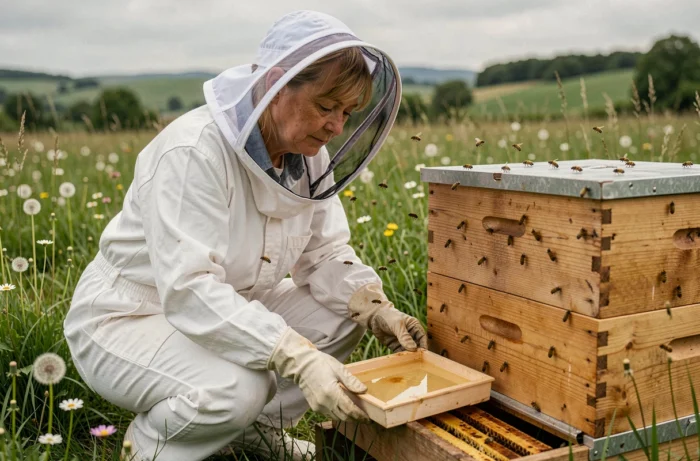
Feeding does not compensate for poor hive management. Feeding your bees remains a technical gesture that responds to specific situations, and if miscalibrated, it destabilizes the colony more than it supports it. Before pouring any syrup, one must know how to read the state of the reserves and understand what the colony really needs.
Sugar/water ratio of the syrup: dosages according to beekeeping objectives
A feeding syrup has a different concentration depending on whether you are stimulating brood production or building winter reserves. Confusing the two sends the wrong signal to the colony.
The light syrup (50/50 by weight) mimics a nectar flow. The bees store it slowly, the queen interprets this input as a resource coming in, and she accelerates egg-laying. We use it in spring when the brood frames need to develop before the first nectar flow.
The heavy syrup (two parts sugar to one part water) is used to build reserves. The bees dehydrate it faster and cap it quickly. This is the appropriate dosage at the end of summer, after the last harvest, when the colony needs to store before winter. Giving light syrup at this time forces the bees to ventilate more, which unnecessarily exhausts them.
We recommend finding feeding advice for bees tailored to each season to avoid these common dosage errors among beginners.
White crystallized sugar (pure sucrose) remains the base. Brown sugar, honey of unknown origin, or industrial syrups containing high proportions of maltose pose health risks for the bees’ digestive system, especially in winter when they cannot perform cleansing flights.

Candy or syrup in winter: criteria for choosing winter feeding
Candy is the only acceptable feed in the dead of winter. Below the cluster, bees do not move to a liquid feeder. Candy, placed directly on the tops of frames under the cover, remains accessible without breaking the cluster.
A standard beekeeping candy consists of powdered sugar and honey (or inverted sugar syrup) worked until it forms a firm paste. Texture matters: too soft, it flows between the frames; too hard, the bees struggle to take it.
When to switch from candy to syrup
The transition occurs when outdoor temperatures regularly exceed the thresholds that allow bees to go out and ventilate. In practice, we observe that the switch to light stimulation syrup coincides with the first visible pollen returns on the landing board.
Giving syrup too early after winter, while nights remain cold, causes excessive condensation in the hive. This humidity promotes nosema and can kill already weakened colonies.
Assessing reserves before feeding: the rear weighing of the hive
Feeding “just in case” without assessing the actual reserves is a common mistake. Excess feeding blocks the laying space: bees store syrup in the central cells, and the queen has no room to lay.
The rear weighing remains the most reliable method. By lifting the back of the hive with one hand, an experienced beekeeper estimates the relative weight. For a beginner, a hook scale attached under the rear handle provides a reproducible measurement.
- A properly stocked Dadant hive for winter has a total weight significantly higher than that of an empty hive equipped with its built frames. If the difference is small, a supplement is necessary.
- During the season, a rapid weight loss over several consecutive days signals a sudden stop in nectar flow, a situation where an input of light syrup prevents a laying blockage.
- After an end-of-summer anti-varroa treatment, weighing allows checking that the supplementary feeding has been properly stored before the first cold weather.
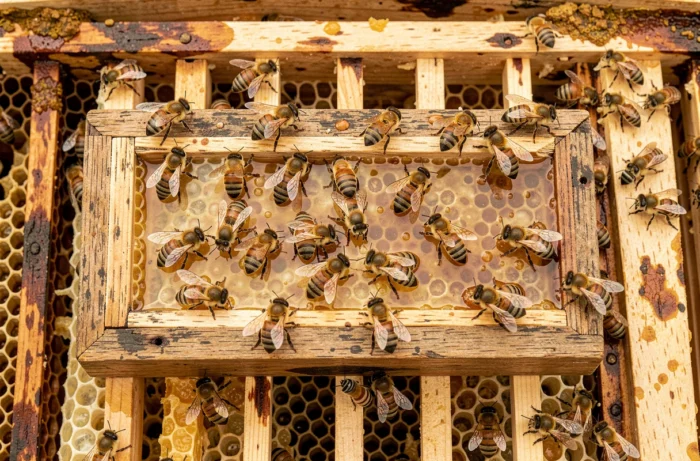
Summer feeding and climate stress: water before sugar
Periods of drought and heatwaves change feeding management. Recent field returns show that the first measure during hot weather is not sugar but access to a stable, clean water source located close to the apiary.
Without water, foragers travel considerable distances to supply themselves, which reduces the active population in the hive and weakens the colony. A simple watering device with clay balls or floating corks is sufficient to meet their needs.
Summer feeding with light syrup occurs when the nectar flow suddenly stops mid-season, not just in preparation for winter. If the edge frames empty and the bees begin to cannibalize the brood, a short-term input over two to three days can restart the cycle. Waiting until a hive is already weakened to intervene complicates recovery.
Choosing the feeder: cover, frame, or entrance
The type of feeder determines the speed of uptake and the risk of robbing between colonies.
- The cover feeder (Nicot type) offers the greatest capacity and limits robbing since access is from above, inside the hive. It is the standard for mass feeding at the end of summer.
- The frame feeder fits in place of an edge frame. Its capacity is lower, but it is well-suited for nucleus hives and fractional spring stimulation inputs.
- The entrance feeder (Boardman type) exposes the syrup outside. It easily triggers robbing and attracts wasps. We do not recommend it except for very small, occasional inputs on isolated colonies.
Regardless of the model, a float or anti-drowning grid in the syrup area reduces mortality. Cleaning the feeder with hot water between each refill limits mold development.
Properly conducted feeding relies on three elements: a prior diagnosis through weighing, a dosage adapted to the season, and clean equipment. Any intervention without prior assessment of the colony’s state risks creating more problems than it solves.