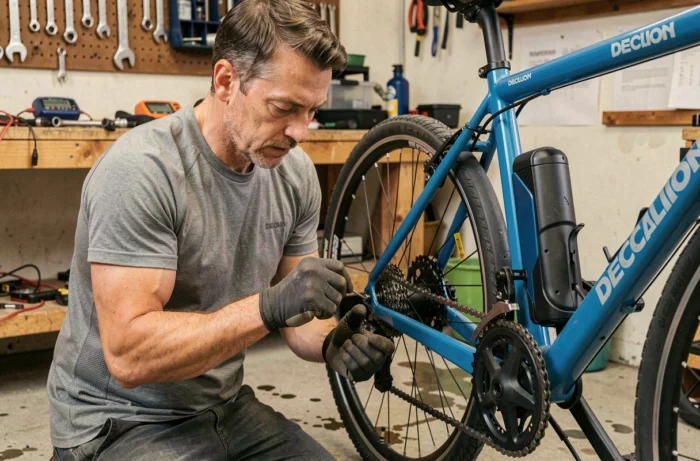
An electric bike from Decathlon displaying an error code on its screen, assistance that cuts out mid-climb, or a battery that refuses to charge: these situations affect Elops models as well as Riverside or Rockrider. Correctly diagnosing the fault before intervening helps avoid replacing an expensive component when the problem is simply a disconnected cable or outdated firmware.
Software lock or hardware failure: what the diagnosis reveals about Decathlon bikes
On recent Decathlon electric bikes, some of the malfunctions in the assistance system do not stem from a physical failure. The controller or the motor firmware may block assistance after an interrupted update, a misaligned speed sensor, or a poorly connected battery contact. The table below distinguishes symptoms based on their probable origin.
| Observed symptom | Probable software origin | Probable hardware origin |
|---|---|---|
| Assistance abruptly cut off | Firmware error, desynchronized pedal sensor | Oxidized motor connector, severed cable |
| Battery not recognized | Software lock after update, BMS in protection | Dirty battery contacts, faulty cells |
| Error code displayed on screen | Communication bug between controller and display | Damaged speed sensor, faulty temperature probe |
| Progressive loss of power | Software limitation related to temperature | Battery cell wear, detached motor magnets |
| Screen not turning on | Reset needed after power cut | Blown internal fuse, cut display ribbon |
This distinction changes the repair method. A workshop that starts by replacing the battery without checking the firmware status risks charging for an unnecessary part. Resetting the electronic system, accessible via the Decathlon app or through a documented manual procedure, resolves a significant portion of error codes.
To delve deeper into each type of failure, a discussion thread lists Decathlon electric bike failures on Retro’ Revue with user feedback categorized by model.
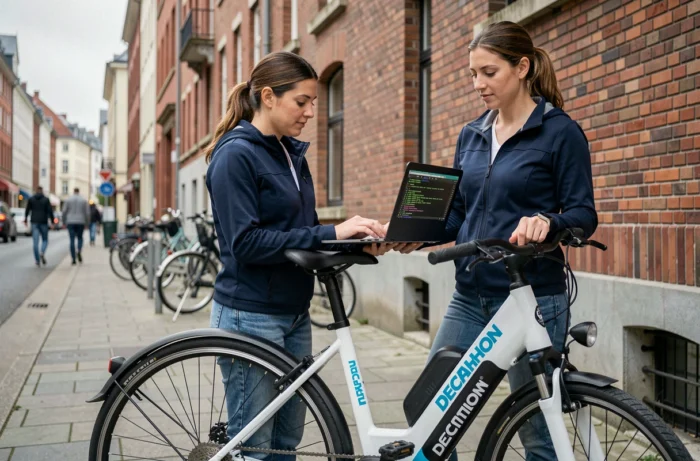
Battery and electrical connections diagnosis: the elimination method
The battery concentrates the majority of questions. Before concluding a cell failure, three checks can eliminate the most common causes.
- Battery-frame contacts: an oxidation or dust deposit on the pins prevents recognition by the controller. Cleaning with isopropyl alcohol and thorough drying is sufficient in most cases.
- Motor cables and connectors: cables passing near the crankset or derailleur experience friction. A slightly loose connector causes intermittent cuts in assistance, often mistaken for a battery issue.
- Status of the BMS (Battery Management System): when the battery remains stored discharged for several weeks, the BMS may enter deep protection. Some Decathlon chargers include a slow wake mode, but others require a workshop visit to force reactivation.
A BMS in protection is not a dead battery. This confusion leads to premature replacements. The manual for the Elops 920 E Connect specifies the reset procedure for this particular case.
When the problem comes from the pedal sensor
The pedal sensor (or torque sensor, depending on the models) transmits the pedaling information to the controller. If it is misaligned by a few millimeters, assistance will not trigger or will react with a noticeable delay. On the Riverside and Rockrider, this sensor is attached by a magnet to the chainring. A shock or clumsy disassembly at the crankset is enough to move it.
The diagnosis is simple: with assistance mode activated, slowly turn the pedals while unloaded. If the screen shows no detection of pedaling, the sensor or its magnet is at fault. Repositioning the sensor can be done without specific tools, by adjusting the gap between the magnet and the detector according to the manual’s instructions.
European regulation on the reparability of e-bike batteries
The legal framework concretely changes what an electric bike owner can demand in terms of repair. The European directive 2024/1799 and regulation 2023/1542 impose, starting from July 31, 2026, the prohibition of certain software or technical locks preventing battery repair. For Decathlon bikes, this means that a battery can no longer be treated as a non-repairable block by default.
In practice, an independent workshop or an equipped individual can legitimately intervene on the cells of an e-bike battery without the manufacturer opposing a firmware lock. This evolution directly concerns models whose BMS previously restricted access to diagnostic data.
What the French decree on planned obsolescence changes
Decree No. 2023-293 of April 19, 2023, followed by the Ministry of Ecological Transition, strengthens the obligation to make manufactured products repairable. Applied to the electrical components of bikes, it complements the European regulation on batteries. A manufacturer can no longer refuse to supply the spare parts necessary for restoring the assistance system.
Decathlon already offers an online catalog of spare parts, covering the mechanical and electrical components of its main ranges. Actual availability varies by model and production year, but the regulatory framework encourages expanding this offer.
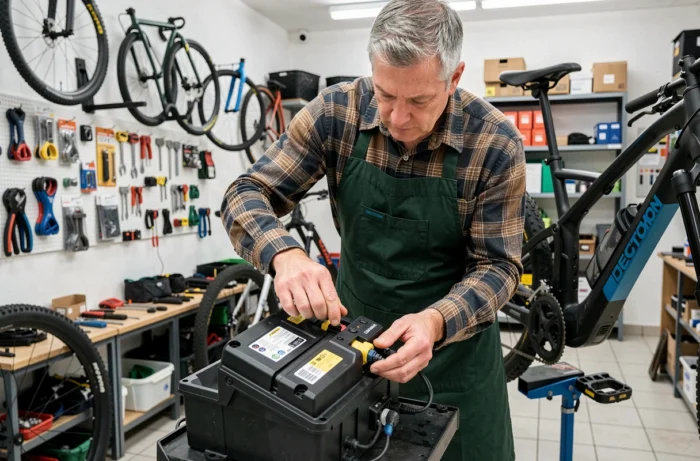
Decathlon workshop or independent repairer: criteria for choice
The workshops integrated into Decathlon stores charge for diagnostic and revision services at displayed rates. Firmware updates and electronic diagnostics are accessible there, as technicians have proprietary software tools.
In contrast, independent repairers specializing in e-bikes sometimes offer shorter turnaround times and more in-depth expertise on generic components (hydraulic brakes, drivetrains, wiring). The choice depends on the nature of the failure: a firmware or warranty issue points towards the Decathlon workshop, while a classic mechanical wear issue can be handled by any competent workshop.
- Firmware failure, persistent error code, battery under warranty: Decathlon workshop, which has the software diagnostic tools.
- Brakes, drivetrain, cables, tires: any qualified bike workshop, often with a shorter intervention time.
- Battery cell replacement or connector soldering: specialized lithium battery repairer, with appropriate certifications.
The diagnosis always precedes the choice of workshop. Identifying whether the failure is software, electrical, or mechanical helps avoid unnecessary back-and-forth and directly target the right contact. The European regulation on battery reparability reinforces this logic: the failure of a Decathlon electric bike is no longer a black box reserved for the manufacturer’s network.