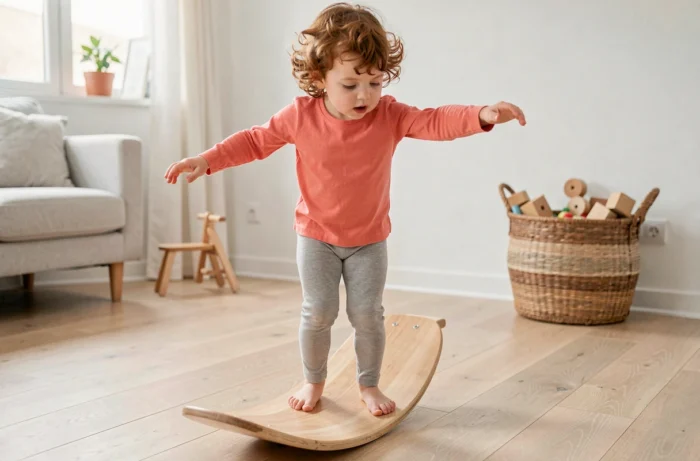
A three-year-old flips the board, places a cushion on top, and declares it a boat. Ten minutes later, he is standing and rocking back and forth, focused on his balance. The Wobbel board works exactly like that: no rules, no user manual, just a curved piece of beech wood that adapts to whatever the child decides to do with it.
Wooden toy safety standards: what the Wobbel really guarantees
It is often assumed that a wooden toy is “naturally” safe. The reality is more technical. The Wobbel board is made from FSC-certified European beech, which ensures verifiable forest traceability. The wood is stacked in layers, pressed, and bent under high pressure to achieve the characteristic curve.
In terms of regulations, wooden toys sold in Europe must pass a series of precise tests: EN 71-1 for mechanical and physical safety, EN 71-2 for flammability, EN 71-3 for the migration of 19 chemical elements, not to mention the formaldehyde test according to standard EN 717-1 and packaging compliance. Since 2025, the European regulation on toy safety prohibits the intentional use of PFAS (per- and polyfluoroalkyl substances) in toys or their components.
For parents comparing several brands of balance boards, one can explore the benefits of the Wobbel balance board in detail, particularly regarding motor and playful aspects. This strengthened European regulatory framework serves as a true quality filter at the time of purchase.
Vestibular stimulation with the Wobbel board: what happens concretely
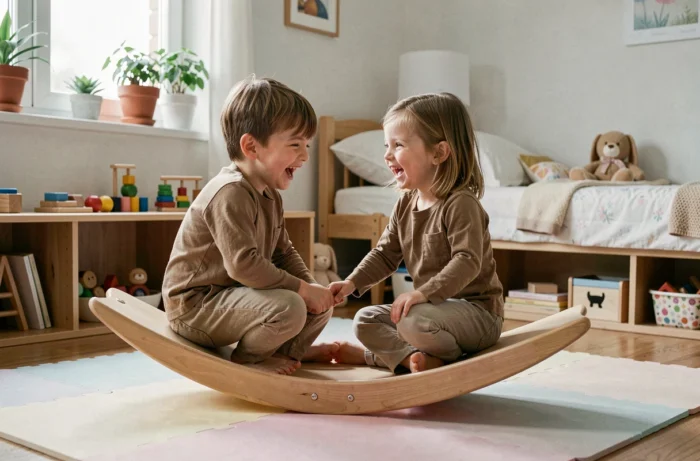
The vestibular system, located in the inner ear, processes information related to the body’s position in space. When a child rocks on the Wobbel, their brain must constantly adjust posture to maintain balance. It is this continuous correction work that strengthens coordination.
A poorly stimulated vestibular system can lead to postural and coordination disorders in children. This is sometimes seen in children who have difficulty sitting still in class or who frequently stumble.
With the Wobbel, the exercises are simple and progressive:
- Rocking back and forth on the knees, then standing, to work on sagittal balance
- Standing on one foot in the center of the board, which engages the stabilizing muscles of the ankles and pelvis
- Lying on the back and letting oneself be rocked, a sensory regulation exercise also used in therapeutic support
Feedback varies on this point, but several parents report a visible improvement in their child’s stability after a few weeks of regular use.
Free play and child development: why the Wobbel surpasses the classic toy
The Wobbel has no predefined function. It is an open-ended toy in the strictest sense: the child decides the use at every moment. One day, it’s a slide for figurines. The next day, a bridge. The following week, an overturned hut with a blanket.
This type of free play activates creativity in a way that electronic toys or screens do not replicate. The child does not follow a programmed scenario; they build their own. It is observed that children as young as two or three spontaneously invent scenarios with the board, while older children (seven, eight years) use it more for balance challenges or as improvised furniture.
The board supports weights of up to 200 kg, meaning it remains usable by teenagers and adults. It can be used for stretching, core exercises, or simply as a dynamic seat in front of a desk. It is a toy that does not end up in the attic after two years.
Some concrete repurposing observed
The most common uses far exceed rocking. They include:
- The board turned upside down as an arch to create a track for small cars or a tunnel for wooden animals
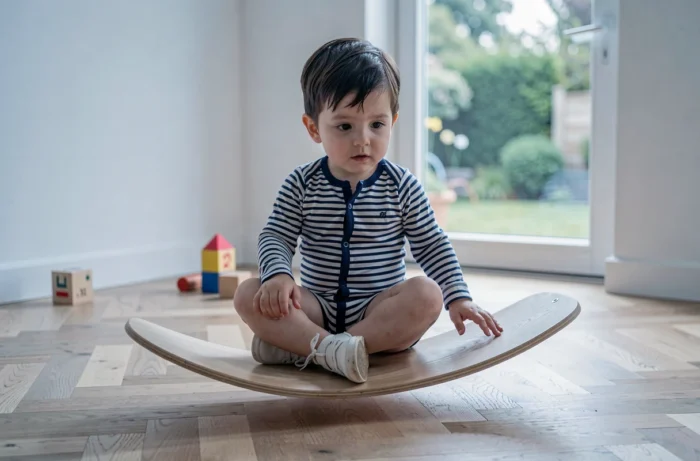
- A reading support, with the child sitting in the hollow with a cushion, rocked by the gentle movement
- A calming sensory time, where the child lies down and rocks gently, useful at the end of the day to regulate excitement
- A controlled sliding ramp, placed against a sofa, with a receiving cushion at the bottom
Choosing the right Wobbel board according to the child’s age
Wobbel offers several models, and the choice primarily depends on the child’s age and size. The Wobbel Starter is suitable for children from about 18 months, with a less pronounced curve and smaller dimensions. It provides a safe first contact with rocking.
The Original (or Standard) model is the most versatile. It accompanies the child from preschool through adolescence. The XL version is aimed at larger sizes or adults who wish to use it for fitness or rehabilitation.
The choice of covering also matters. The felt glued under the board reduces noise on hard floors and protects the parquet. Without felt, the board slides more, increasing the difficulty of balance but potentially marking delicate surfaces. For use in an apartment, felt is almost necessary.
The Wobbel remains a sustainable investment. The pressed European beech wood withstands repeated impacts, and the design without moving parts eliminates the risk of mechanical breakage. A wooden toy of this quality can last through several children without showing structural weakness, which puts its price into perspective compared to plastic toys that are replaced every season.