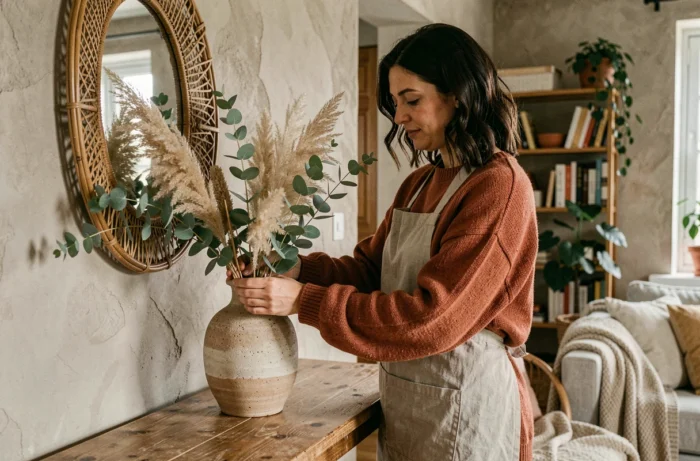
Personalizing an interior is not just about choosing a wall color or arranging a few cushions. Customizing your interior decoration involves mastering the interactions between materials, finishes, and recent regulatory constraints that reshape the available offerings in furniture and decorative objects.
Formaldehyde and decorative panels: what the REACH regulation changes for your custom furniture
The regulation (EU) 2023/1464 imposes, starting from August 6, 2026, formaldehyde emission limits on new furniture and furnishings. For wood-based products (particle boards, MDF, melamine), the threshold is set at 0.062 mg/m³. Other items, textiles, plastics, and leathers, are capped at 0.080 mg/m³.
This constraint directly impacts customized decoration. A custom MDF lacquered piece, a headboard made of chipboard covered in fabric, or a wall storage unit in melamine must now comply with these limits. We recommend systematically checking the technical data sheet of the panels before placing any orders with a carpenter or designer.
Finishes based on urea-formaldehyde resins, still common in entry-level products, are the first to be affected. Opting for E0.5 certified panels or solid woods remains the safest path for a sustainable interior decoration project. Additionally, specialized brands like nananere-deco.fr offer decorative pieces whose materials are carefully selected.
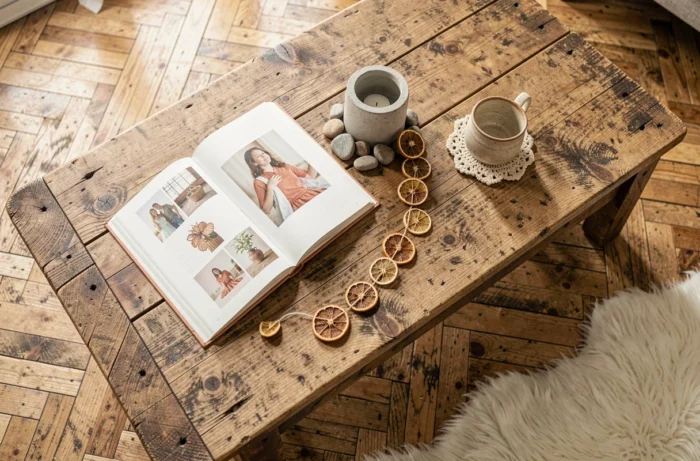
Environmental score in decoration: anticipating mandatory labeling
The Climate and Resilience Law provides for the gradual implementation of an environmental score for furniture and decoration products. Experiments began in 2024. The transition to a mandatory system is expected by 2027.
In practical terms, each light fixture, each piece of furniture, each customized decorative object will be accompanied by a score visible to the consumer. Brands that focus on customization (choice of fabric, color, dimensions) will need to incorporate this score into their offerings.
For an ongoing decoration project, this means that pieces purchased today without environmental information will soon become a minority in the market. We are already observing a shift in catalogs towards ranges whose carbon footprint and material origins are documented. It’s better to get used to this now.
Trendy colors and textures: pairing muted tones and raw materials
The color palettes dominating interior design in 2026 are moving away from the ubiquitous off-white of recent years. Earthy tones (terracotta, ochre, sage green) are taking over, combined with textures that break the uniformity of smooth surfaces.
The layering of raw materials adds depth to a space without requiring major renovations. A wall with a troweled finish, a floor in reconstituted stone, a piece of furniture in raw oiled wood: these elements create a visual dialogue that paint alone cannot offer.
Combinations to favor
- Natural stone or waxed concrete flooring, paired with washed linen textiles for seating and curtains, to temper the mineral coldness
- Oak or walnut paneling as a screen or wainscoting, combined with a lime-based plaster tinted in the mass for the walls
- Patinated metal (aged brass, brushed steel) on light fixtures and handles, contrasting with matte and absorbent surfaces
The classic trap remains the accumulation of textures without hierarchy. We recommend limiting the number of visible materials to three or four per room and reserving shiny or metallic finishes for small accent pieces.
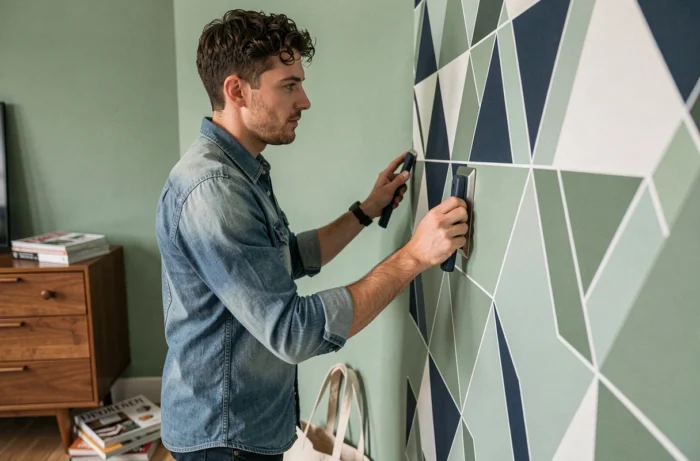
Personalization through plants and wall art: going beyond the decorative stage
Indoor plants have moved beyond purely ornamental status. A stabilized green wall or a set of handcrafted pottery structures a space as much as a partition. The choice of containers, their arrangement, and the scale relationship with the furniture matter more than the botanical variety.
On the walls, custom printed art (large format photographs, numbered screen prints) is gradually replacing standardized decorative canvases. The benefits are twofold: the format adapts exactly to the available surface, and the piece gains in uniqueness.
Selection criteria for a personalized art wall
- Ratio between the wall width and the artwork size: covering between half and two-thirds of the available horizontal surface for a balanced visual impact
- Depth of the frame or support: a thick frame (over three centimeters) casts shadows that enhance the presence of the piece
- Color coherence with the room’s textiles, not with the wall color, to avoid a camouflage effect
Directional lighting enhances a wall composition much more than the quality of the print itself. A track of adjustable spotlights or a picture light fixture is enough to transform a wall into a focal point.
Antique furniture and repurposing: an underestimated lever of personalization
Incorporating a piece of antique furniture into a contemporary interior is not merely an aesthetic whim. A 1950s sideboard transformed into a vanity unit, a workshop bench repurposed as a kitchen island, or an old door mounted as a headboard brings a narrative density that no new piece can replicate.
Repurposing works as long as the proportions of the room are respected and “statement” pieces are not multiplied. One strong antique piece per space is enough to anchor the style. The rest of the furniture plays a neutral background role.
Provenance also matters: local flea markets, recycling centers, and regional auctions offer pieces with authentic patina, far from the artificially aged finishes of industrial new items. Environmentally, reusing fits naturally into the logic of future environmental labeling, as an antique piece generates no additional production emissions.
Personalizing your interior decoration today requires combining aesthetic sensitivity with knowledge of technical constraints. The new standards on formaldehyde, the arrival of the environmental score, and the evolution of palettes towards raw materials reshape the possible choices. The best decorative investment remains a piece that tells a story, whether it comes from a cabinetmaker’s workshop or a village flea market.