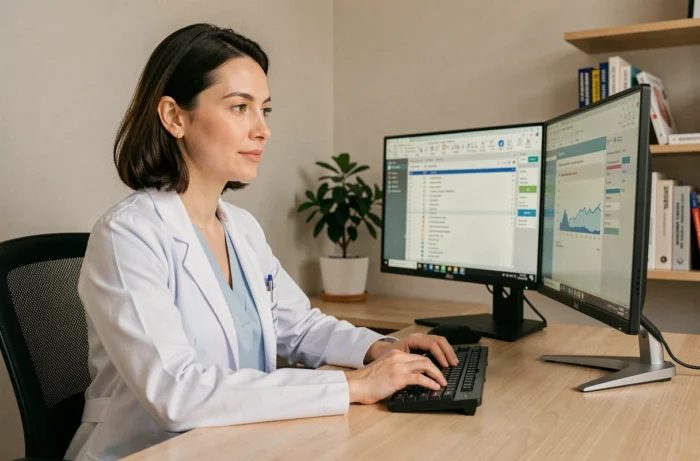
A general practitioner who switches between three software programs to write a prescription, send a report, and bill for a service loses considerable time each day. This time, taken away from consultations, impacts the quality of patient follow-up and the mental load of the practitioner. Digital solutions dedicated to online healthcare professionals specifically aim to address this problem: reducing administrative friction to refocus daily activities on care.
Requirements of the Ségur numérique for online health software
Have you heard of the Ségur du numérique in health without knowing exactly what it changes for your practice software? The principle is simple: the State funds the upgrading of digital tools for healthcare professionals, provided that these tools meet a specific set of requirements.
In practical terms, a Ségur-referenced software must automatically feed into Mon espace santé, use the secure messaging MSSanté, and ensure interoperability with other stakeholders in the care pathway. For doctors and pharmacists, this transition is already underway.
The new development concerns paramedical professions. An order dated July 15, 2026, published in the Official Journal on July 21, 2026, opens wave 2 of funding for nurses, physiotherapists, speech therapists, orthoptists, podiatrists, and midwives. The effective transition to referenced software is expected in early 2027. In the meantime, no paramedical professional can yet receive Ségur funding in this area.
For online solution providers, this creates a strategic window: integrating interoperability requirements now allows them to be ready when paramedical professionals seek a fundable tool. Practitioners who wish to access Médic Activ for professionals can already compare the features offered against these regulatory criteria.

Health data hosting: what the HDS v2 certification changes
When a healthcare professional uses online software, their patients’ data is transmitted through remote servers. The question arises: are these servers sufficiently protected?
The HDS (Health Data Host) certification is mandatory for any provider that stores or processes personal health data. Version 2 of this framework, aligned with the ISO 27001 standard in its 2022 revision, strengthens requirements on several points.
- Compliance audits must now explicitly cover the management of technical subcontractors, including cloud providers located outside the European Union.
- The scope of certification extends to administrative and operational activities, not just the physical hosting of servers.
- Providers have a transition period to comply, meaning that not all software currently on the market meets these new requirements yet.
In practice, a healthcare professional choosing an online solution must verify that the provider displays an up-to-date HDS certification. An uncertified HDS software exposes the practitioner to direct legal risk, as the responsibility for data processing remains shared between the host and the professional.
Online practice management software: features that make a difference
Competitors often focus on appointment scheduling or patient records. These components have become a minimum requirement. What truly distinguishes a useful daily solution is the ability to reduce repetitive micro-tasks.
Automated billing and teletransmission
A software that automatically prepares the electronic care sheet from the actions entered during the consultation saves several minutes per patient. Automating teletransmission eliminates manual re-entries and decreases rejections from health insurance organizations.
Integrated secure messaging
Sending a report to a colleague via regular email poses a confidentiality issue. Solutions that directly integrate MSSanté into their interface allow for the exchange of clinical documents without leaving the software. The benefit is not only regulatory: it reduces the number of clicks and applications open simultaneously.
Connected prescription assistance
Some tools offer an updated medication database, with interaction detection. A connected prescription module alerts the practitioner before validating the prescription, which limits errors related to polypharmacy, common among chronic patients.

Teleconsultation and remote patient follow-up: choosing the right scope
Teleconsultation has firmly established itself in medical practice. Not all platforms offer the same level of integration with the rest of the management software.
An isolated videoconferencing tool forces the practitioner to manually transfer the information gathered to the patient record. In contrast, an integrated solution directly records consultation notes, prescriptions, and documents shared during the session in the patient’s file.
Remote follow-up extends the effect of the consultation. Follow-up forms automatically sent to the patient (post-operative questionnaires, pain scales, blood pressure readings) populate the record without practitioner intervention. This mechanism is particularly useful for chronic conditions, where therapeutic adjustments rely on data collected between two appointments.
Why does this choice of scope matter so much? Because software that manages teleconsultation without linking it to the patient record creates an additional data silo. The professional then finds themselves manually consolidating scattered information, which negates the benefits of dematerialization.
Concrete criteria for evaluating a digital health solution
Before committing to a provider, a few practical checks can help avoid unpleasant surprises.
- Verify the up-to-date HDS certification of the host, by requesting the certificate and not just a mention on the site.
- Test real interoperability: can the software import a CDA document (the standard format for shared medical records) without loss of information?
- Assess the training time required: a solution that requires several days of onboarding may slow down the practice’s activity during the transition.
- Ensure that the provider is actively preparing for Ségur wave 2 compliance, especially for paramedical professions that will be affected starting in 2027.
The choice of online health software commits the practice for several years. Prioritizing a provider that is transparent about its regulatory roadmap remains the best indicator of medium-term reliability. Practitioners who invest now in a tool compliant with Ségur and HDS v2 requirements avoid costly migration in the coming months.