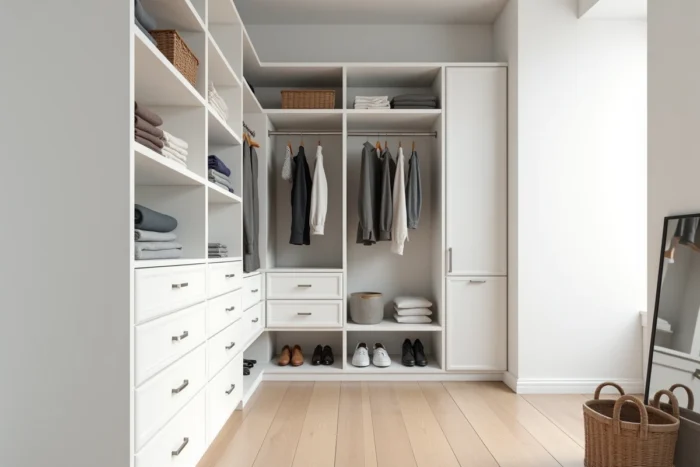
Furnishing a white dressing without exceeding a few hundred euros requires comparing the available formats at DIY superstores. Brico Dépôt offers standard modules, complete kits, and customizable elements, all available in white. The price varies depending on the chosen format, the width of the module, and the type of closure. This article measures the cost and functionality differences between these options to identify the most cost-effective combination.
White dressing in kit or modular: price and flexibility gap
At Brico Dépôt, two approaches coexist for a white dressing. The complete kit includes a wardrobe, shelves, and drawers in a single package, at a fixed price. The modular dressing allows you to purchase each column, shelf, or rail separately.
| Criteria | Complete dressing kit | Modular dressing to assemble |
|---|---|---|
| Principle | Ready-to-assemble set, fixed configuration | Columns, shelves, and accessories sold individually |
| Adaptability to dimensions | Standardized widths, little margin | Free combination according to available space |
| Subsequent addition | Limited to compatible accessories | Adding a column or shelf at any time |
| Estimated assembly time | Faster (one instruction manual) | Longer (multiple references to assemble) |
| Controlled budget | Price visible from the purchase | Risk of exceeding the budget by adding modules |
The kit remains the cheapest format for a functional white dressing. It is suitable for spaces where the width matches the proposed dimensions. The modular format, on the other hand, better accommodates the constraints of an atypical room (sloped ceiling, recess, L-shaped wall).
For a particularly tight budget, the white dressing at 79 euros at Brico Dépôt perfectly illustrates the brand’s entry-level positioning in this segment.
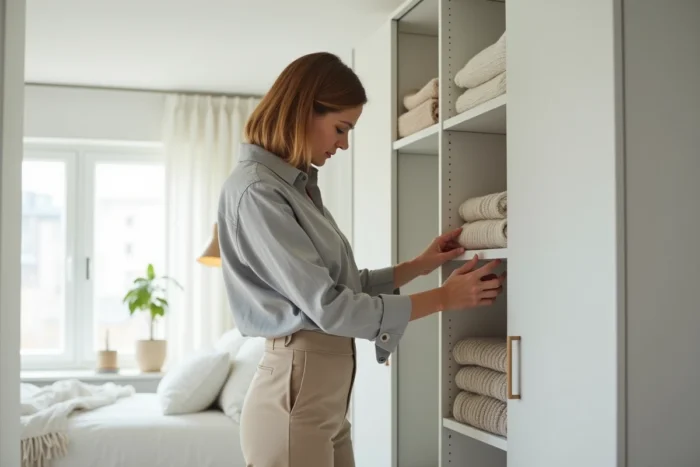
White finish and customization: what the base price does not cover
The white offered on Brico Dépôt dressings is a matte or slightly satin melamine. This coating resists common friction and is easy to clean. It provides a neutral base that is easy to coordinate with touches of wood, gold, or black for a more refined look.
Customization revolves around three areas that the kit price does not include:
- Handles: replacing standard handles with brushed brass or leather models radically changes the appearance of the furniture, for just a few euros per piece.
- Interior lighting: an adhesive LED strip placed at the top of each column makes the contents visible and gives an impression of depth. Brico Dépôt sells this type of accessory in the electrical section.
- Storage accessories: fabric baskets, drawer dividers, or belt racks can be added after assembly and structure the space without altering the furniture.
These additions represent a moderate extra cost. The majority of the budget remains on the module itself, and customization is done gradually, which spreads the expense.
Brico Dépôt dressing versus artisanal solutions: where the difference lies
On renovation forums, buyer feedback often contrasts Brico Dépôt with carpenters and specialized brands. The observation frequently comes back to the same point: the artisan offers custom solutions but at a significantly higher cost.
The standard white dressing from Brico Dépôt serves as a solid structural base. The depth of the boxes, the hardware, and the hinges correspond to normal domestic use. Limitations appear in the edge finishes, the thickness of the panels, and the absence of soft-close drawers in the entry-level ranges.
Acceptable compromises depending on the project
For a guest room or studio, a budget white kit fulfills its function without visible compromise. The white melamine masks the simplicity of the structure and integrates into most decors.
For a master bedroom where the dressing remains open at all times, investing in the modular range allows for the selection of thicker fronts and better-guided drawers. The extra cost compared to the kit remains well below a carpenter’s quote.
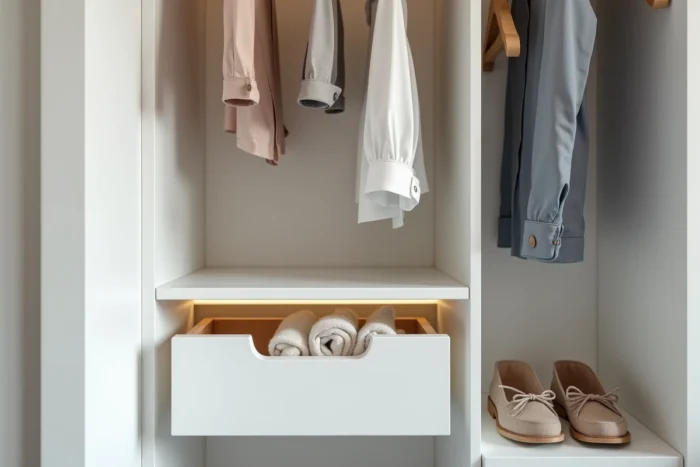
Optimizing every square meter: configuring the white dressing in a small space
Compact housing requires thinking about the dressing in height rather than width. Brico Dépôt offers columns that rise to over two meters, freeing up floor space.
Three configuration rules maximize storage in a reduced space:
- Place the wardrobe rail at mid-height and add a second rail below for short clothes (shirts, skirts). This double wardrobe doubles the capacity without widening the furniture.
- Reserve the high shelves for rarely used items (suitcases, blankets). The uniform white of the shelves and storage boxes creates a visual continuity.
- Use sliding doors instead of hinged ones. Sliding doors save the entire swing area, freeing up a passage or the space for another piece of furniture.
The sliding doors and hardware section at Brico Dépôt offers kits compatible with most boxes in the range. The rail can be fixed to the ceiling or mounted on the wall, depending on the wall configuration.
All white or two-tone: visual impact in a small volume
An entirely white dressing visually enlarges the room by blending with the light walls. Adding a light wood back panel or discreet patterned wallpaper on the back wall of the dressing creates a depth effect without notable extra cost.
This trick works particularly well with open dressings (without doors), where the back of the furniture remains visible at all times.
Thus, the white dressing from Brico Dépôt covers a wide spectrum, from the entry-level kit to the customizable modular assembly. The cost difference with an artisanal solution remains the determining factor for most budget-limited projects. The choice between kit and modular primarily depends on the regularity of the walls and the available width: a standard space leans towards the kit, a constrained space towards the customizable modules.