
The organic Noni juice intended to accompany a weight loss regimen comes in various forms: pure fermented juice, pasteurized juice, diluted fruit blend. Behind the “organic” label, the actual composition, manufacturing process, and regulatory status of the product differ from one reference to another. Comparing these parameters helps identify what distinguishes a truly usable organic Noni juice in a weight loss approach from a simple flavored cocktail.
Novel food status and European regulation of organic Noni juice
Noni (Morinda citrifolia) is listed among the novel foods authorized in the European Union. This authorization does not cover just any product labeled “noni”: only certain forms of preparation are explicitly described in the authorization list (juice, juice powder, etc.), with specific dosage and manufacturing process conditions.
For a weight loss regimen that spans several weeks, this distinction has a direct consequence. An organic Noni juice sold as a dietary supplement must correspond to one of the regulatory-defined preparations. A product labeled “organic Noni juice” without technical details on the type of preparation or the matrix used may be regulatory ambiguous.
Before purchasing, checking that the manufacturer explicitly mentions compliance with novel food status and the type of authorized preparation remains the first step to eliminate vague products. To better understand the benefits of Noni Juice in a weight loss context, one must first ensure that the consumed product falls within this legal framework.
Pure fermented juice, pasteurized or diluted: comparative table of available forms
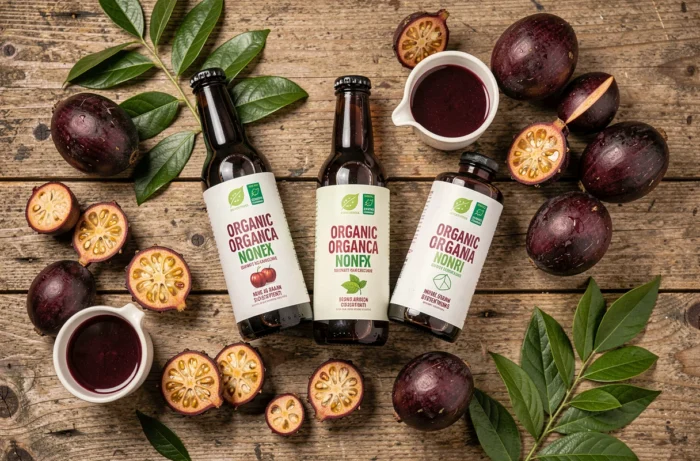
The organic Noni juices sold in France are divided into three main categories. Their characteristics directly influence nutritional interest and relevance for a weight loss regimen.
| Criterion | Pure fermented juice | Pure pasteurized juice | Fruit blend / diluted |
|---|---|---|---|
| Noni content | 100% fermented pulp | 100% pulp, non-fermented | Variable, often minority |
| Taste | Very bitter, pronounced | Less bitter, sweeter | Masked by other fruits |
| Frequent additions | None | None or preservative | Fructose, flavors, colorants, water |
| Nutritional profile | Enriched by fermentation (bioactive compounds) | Preserved if gentle pasteurization | Diluted, reduced Noni contribution |
| Potassium | High content | High content | Reduced content due to dilution |
| Relevance for weight loss | Strong (maximum concentration) | Correct | Low (possible added sugars) |
Pure fermented juice concentrates the most active compounds, but its marked bitterness may hinder adherence to a regimen lasting several weeks. Pure pasteurized juice offers an acceptable compromise as long as the pasteurization remains gentle.
On the other hand, fruit blends pose a concrete problem for weight loss: the addition of fructose, sugar, or flavors increases caloric intake and reduces the actual proportion of Noni in the product. The “organic” label does not guarantee the absence of these additions.
Potassium and liver safety: two points to check before a prolonged regimen
Recent technical syntheses on Noni raise two points of caution rarely mentioned in mainstream content.
Noni is naturally rich in potassium. For a healthy person, this is not an issue on a short regimen. However, over several weeks, this high content may pose a risk for individuals with kidney insufficiency or those undergoing medication that alters potassium metabolism.
The second point concerns the liver. Cases of liver toxicity associated with Noni consumption have been documented in the scientific literature. The causal link remains debated, but caution is warranted for any prolonged regimen, especially if other dietary supplements are taken concurrently.
- Check for the absence of renal or hepatic contraindications before starting a regimen
- Adhere to the dosage indicated by the manufacturer, in line with the novel food framework
- Avoid combining organic Noni juice with other potassium-rich supplements
- Consult a healthcare professional if undergoing ongoing medication
Certificate of analysis and traceability: reading the label of organic Noni juice

The mention “organic” certifies a mode of cultivation, not the final quality of the juice. To evaluate a product, two documents make a difference.
The certificate of analysis (COA) details the actual composition of the batch: active ingredient content, absence of contaminants, microbiological compliance. Serious manufacturers make it accessible upon request or publish it online. An organic Noni juice sold without any analytical traceability does not allow verification of what the bottle actually contains.
The traceability of the raw material also matters. Noni grown in French Polynesia, Southeast Asia, or Central America does not present the same profiles depending on the soils and harvesting conditions. A manufacturer that specifies the geographical origin, harvesting method, and processing provides concrete elements for comparison.
- Request or search for the certificate of analysis of the batch before purchase
- Prefer manufacturers who indicate the geographical origin of the fruit
- Verify that the process (fermentation, pasteurization) is explicitly mentioned
What the label doesn’t always say
Some products display “100% noni” while using reconstituted pulp from concentrate diluted in water. The mention “pure juice” and the mention “from concentrate” do not refer to the same product. In France, regulations on fruit juices impose this distinction, but it remains easy to overlook on packaging laden with marketing claims.
The choice of an organic Noni juice for a weight loss regimen relies less on the promises of the label than on three verifiable data points: compliance with novel food status, composition certified by a certificate of analysis, and the form of preparation (pure fermented juice, pasteurized, or diluted). These criteria eliminate a significant portion of available products, simplifying the selection process.