
A newborn requires a limited number of products and equipment, provided that those chosen meet its actual physiological needs: thermoregulation, safe sleep, feeding, and skin care. Caring for your baby from birth relies less on the quantity of purchases and more on the relevance of each choice.
Mandatory vaccinations for infants: what has changed in 2025
Birth checklists focus on equipment, but a health aspect directly influences the organization of the first weeks. Since January 1, 2025, vaccination against meningococci B and ACWY is mandatory for infants in France.
These vaccines are in addition to the existing requirements. The ACWY vaccination includes a dose at six months and a booster at twelve months, with an extended obligation up to two years for catch-up vaccinations for unvaccinated children. The vaccination schedule, published by the Ministry of Health, details the specific deadlines.
Anticipating these appointments right after leaving the maternity ward helps avoid forgetfulness. The health record remains the reference document: noting each injection over the course of consultations allows for reliable traceability, especially in case of a change of pediatrician. Whooping cough poses a particular risk for those under six months. A cocooning strategy (booster vaccination for close contacts before birth) significantly reduces the risk of transmission to the newborn.
Preparing for the arrival of a child also means discovering Lol Baby for baby to identify suitable equipment for each stage of growth.
Newborn skin care: product composition and appropriate actions
An infant’s skin is thinner and more permeable than that of an adult. This characteristic makes the choice of baby care products crucial from the very first days.
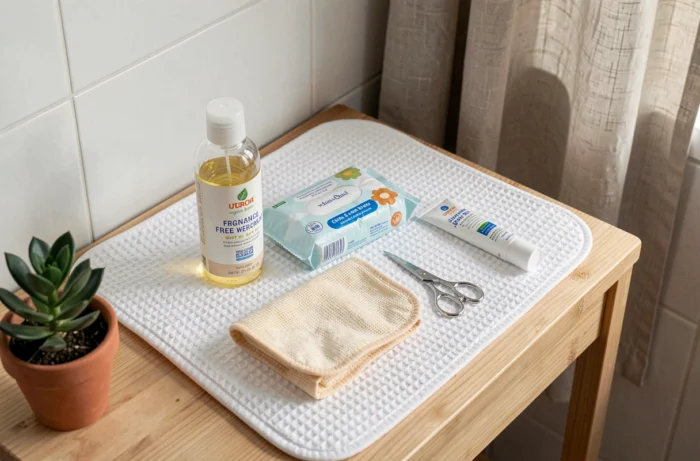
A daily bath is not a necessity. Two to three baths per week are sufficient during the first weeks, supplemented by localized cleaning of the diaper area and skin folds. Warm water alone remains the safest cleanser for a newborn. If a cleansing product is used, it should have a pH close to neutral and a short ingredient list.
Some wipes sold in supermarkets contain ingredients classified as undesirable by independent testing organizations. Checking the composition before purchase protects the fragile skin of the infant. A fragrance-free and preservative-free cleansing milk is a reliable alternative to wipes for diaper changes.
- Prefer certified organic formulations with a minimum of ingredients (four to six identifiable components).
- Avoid products containing phenoxyethanol, often found in baby cosmetics despite health warnings.
- Test any new product on a small area of skin before applying it to the entire body.
Caring for the umbilical cord generally requires only air drying and gentle cleaning. Systematic antiseptics are no longer recommended in most French maternity wards.
Safe sleep space: firm mattress, temperature, and flat sleeping
Sleep occupies the largest part of a newborn’s day. The configuration of the sleeping space directly influences safety and the quality of rest.
The mattress must be firm and perfectly fitted to the dimensions of the bed, with no residual space between the edge of the mattress and the walls. A mattress that is too soft or too small increases the risk of suffocation. The waterproof cover, washable at high temperatures, protects the mattress while facilitating maintenance.
The room temperature plays a direct role in the thermoregulation of the infant. Keeping the room between 18 and 20 °C remains the most widely shared recommendation among health professionals. A sleeping bag suitable for the season replaces a duvet and blanket, which have no place in a baby’s bed.

- No unnecessary objects in the crib: no pillow, no bumper, no stuffed animals during the first months.
- Sleeping on the back, flat, is the recommended position to reduce the risk of sudden infant death syndrome.
- A co-sleeping bed attached to the parental bed facilitates nighttime breastfeeding while maintaining a separate and safe sleeping space.
Breastfeeding and bottle preparation: truly necessary equipment
Feeding the newborn structures daily life right after leaving the maternity ward. Whether the choice is breastfeeding or bottle-feeding, the useful equipment remains limited.
For breastfeeding, two to three nursing bras, absorbent pads, and possibly a breast pump are sufficient to start. The breast pump can be prescribed by a healthcare professional and covered, which avoids premature purchase. A nursing pillow relieves postural tension during feedings, especially in the case of a cesarean section.
For bottle-feeding, plan for three to four small bottles with slow-flow nipples suitable for newborns. Systematic sterilization is no longer considered necessary by all maternity wards: thorough washing with hot water and dish soap, followed by complete drying, is often deemed sufficient.
The infant formula for the first age covers nutritional needs from birth until the introduction of complementary feeding. Changing brands without medical advice can cause digestive issues in an infant whose gastric system is still immature.
Birth clothing: focus on simplicity and comfort
Newborns grow quickly. Accumulating newborn-sized clothing often results in a stock of unused items after just a few weeks. Five to seven bodysuits, the same number of pajamas, and two or three cardigans cover the actual needs for the first weeks.
Cotton remains the reference material for clothing in direct contact with the skin. Synthetic fibers retain heat and promote irritation. Washing each new garment before first use eliminates chemical residues from manufacturing.
Opening systems facilitate frequent changes. Cross-over bodysuits, which can be put on without going over the head, are more practical during the first days than classic models with snaps in the back.
The maternity bag, ideally prepared a month before the due date, gathers the clothing for the stay: two complete outfits for the baby, a sleeping bag, a hat, and socks. The rest waits at home.