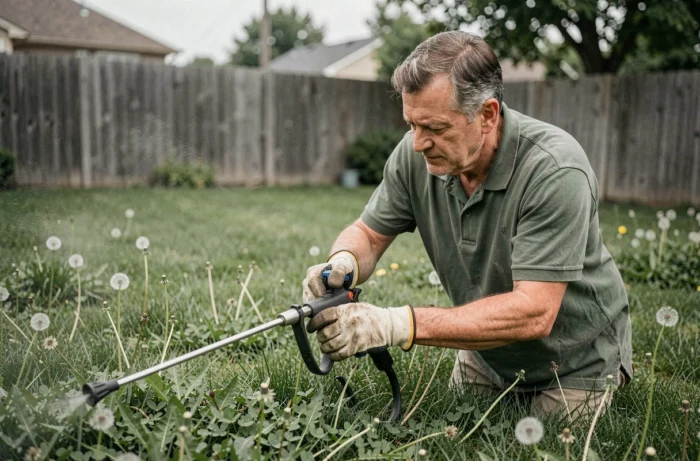
The selective lawn herbicide targets broadleaf weeds (dandelion, clover, plantain) without destroying the grass in the lawn. Since January 1, 2019, synthetic products have been banned for individuals in France: only herbicides labeled EAJ or classified as biocontrol remain freely available. This regulatory framework changes the game regarding product choice, application timing, and expected results.
Regulations and authorized products for individuals
The Labbé law, strengthened on January 1, 2019, bans the sale of synthetic herbicides to amateur gardeners. The only selective herbicides available are those related to biocontrol or labeled “authorized for use in gardens” (EAJ).
These products exploit herbicidal properties of plant or mineral origin. Their mode of action differs from synthetic molecules: they often act by contact rather than systemic translocation, which imposes stricter application conditions to achieve visible results.
Knowing when to apply a selective lawn herbicide is not enough if the product used does not comply with the current legal framework. Checking for the EAJ or biocontrol label on the packaging remains the first reflex before any purchase.
Soil temperature and weed growth stage: the two decisive variables
Most content focuses on the season (spring or fall). This division is useful but incomplete. Two parameters matter more than the month on the calendar.
Soil temperature at the time of treatment
Selective herbicides, even biocontrol ones, lose effectiveness when the soil temperature drops too low or exceeds a certain threshold. Soil that is too hot causes rapid evaporation of the product before it penetrates the tissues of the target plant. Field reports published in 2026 on sports lawns confirm that applications during high heat significantly reduce the control rate of weeds.
Conversely, cold soil slows the metabolism of weeds. The product is absorbed, but the plant does not transport it effectively to its roots. Cool mornings in early spring or late autumn are therefore windows to avoid despite seasonal good intentions.
Growth stage of the weeds
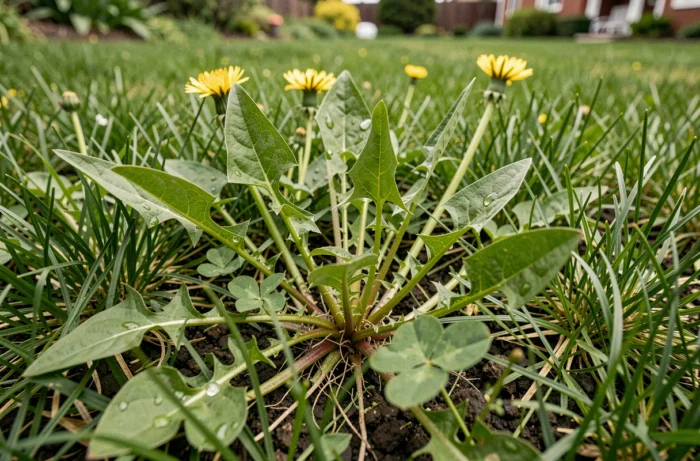
Treating weeds during their active growth stage multiplies the product’s effectiveness. A dandelion rosette developing new leaves absorbs much more active ingredient than a plant that has already gone to seed or is dormant. Treatment should occur before flowering, when the leaf surface is sufficient to capture the product, but before the plant has dispersed its seeds.
Concretely, this points to two preferred time slots:
- Spring, between the vegetative recovery of grasses and the first flowering of weeds, when daytime temperatures remain moderate.
- Early autumn, when perennial weeds resume growth after summer stress, with still warm soil and ambient humidity favorable for absorption.
- Overcast, windless days, regardless of the season, to limit product drift and evaporation.
Weather conditions on the day of application
The choice of the specific day matters as much as the time of year. A treatment applied under poor weather conditions can be completely neutralized.
No rain in the hours following application: most biocontrol products require an extended contact time with the foliage. A shower, even light, dilutes and washes away the product before it acts. Aim for a window without precipitation of at least several hours after spraying.
Wind is an underestimated factor. Beyond a moderate breeze, spray drift deposits the product on non-target areas (beds, vegetable gardens, hedges) and reduces the dose received by the targeted weeds. Applying early in the morning, when the air is calm, remains the most reliable practice.
Avoid heatwave periods is a point confirmed by several sources in 2026: excessive heat stresses the lawn itself, making it more vulnerable to the product intended to spare it. The risk of phytotoxicity on grasses increases significantly when the thermometer exceeds usual summer thresholds.
Weed resistance and limitations of a single treatment
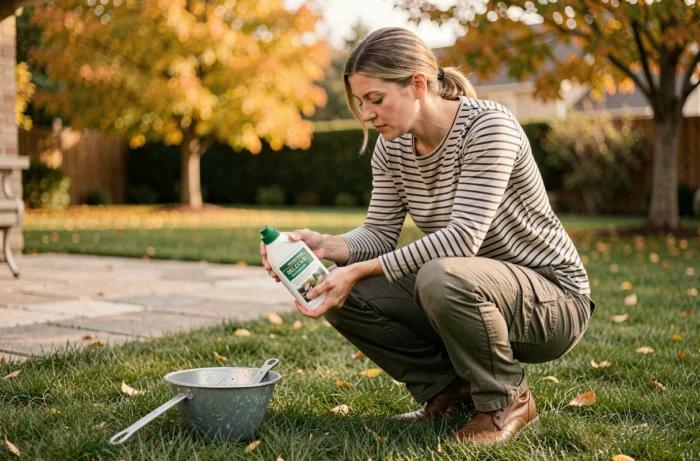
Resistance to herbicides also concerns lawns. Studies published in 2026 on sports lawns document populations of weeds that survive repeated treatments using the same mode of action. This phenomenon, well-known in agriculture, is found in private gardens as soon as a single product is used season after season.
The practical consequence is direct: a single application of selective herbicide does not guarantee the definitive elimination of weeds. Surviving plants pass on their tolerance to their offspring, making subsequent applications less effective.
To limit this risk, combined strategies yield better results:
- Alternate modes of action from one treatment to another when multiple EAJ or biocontrol products are available.
- Combine chemical weeding with cultural practices: appropriate mowing height, overseeding sparse areas, targeted fertilization to thicken the lawn.
- Accept that a selective treatment reduces the population of weeds without necessarily eradicating it, and that a second application a few weeks later is often necessary.
The number of necessary applications depends on the initial density of weeds, the type of soil, and the product used. These variables make any universal rule inapplicable.
Mowing and selective lawn herbicide: what order to follow
Mowing alters the leaf surface of weeds, which has a direct impact on product absorption. Mowing a few days before treatment allows weeds to redevelop sufficient foliage to capture the herbicide. Mowing the day before reduces this surface and decreases effectiveness.
After application, the product must be allowed to act without disturbing the treated foliage. Resuming mowing too early cuts the leaves containing the active ingredient before it is fully absorbed. Waiting at least two to three days before mowing again allows the treatment to take effect.
The French regulatory framework, soil temperature, weed growth stage, and weather conditions on the day form a set of variables to cross-reference. None of these variables operates in isolation. A compliant product applied at the wrong time on dormant weeds in windy weather will yield nothing, regardless of the dosage respected.