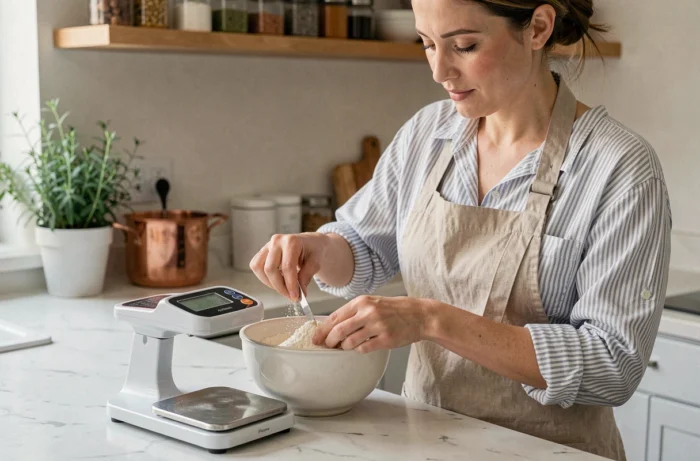
A mass converter transforms a quantity expressed in one unit (grams, ounces, kilograms) into another unit, applying a fixed conversion factor or, for mass/volume conversion, the density specific to each ingredient. In cooking, this operation solves a concrete problem: an American recipe indicates cups of flour, a French recipe asks for grams, and your scale shows ounces because it is set to the wrong mode.
Conversion is not limited to a school calculation. Flour, butter, and honey do not occupy the same volume for the same weight, which makes generic charts often misleading as soon as you move away from simple liquids like water or milk.
Mass and volume in cooking: why density changes everything
Most conversion errors stem from confusion between mass and volume. A glass of flour does not weigh the same as a glass of honey because their densities differ. A reliable converter incorporates this data by ingredient, whereas a fixed correspondence chart often assumes everything behaves like water.
This distinction is especially important in baking. A few extra grams of flour can alter the texture of a cake, making a dough too dry or a batter too dense. For liquids like milk or water, the milliliters/grams correspondence remains close to 1:1, which simplifies things. For powders, fats, or viscous ingredients like honey, the shortcut no longer works.
A beginner’s guide on Mon Blog Cuisine details this logic step by step for those discovering the topic.

In practice, a good converter offers a dropdown menu of ingredients (powdered sugar, butter, flour, cocoa, etc.) and automatically adjusts the result. Selecting the ingredient before converting is the only step that guarantees a reliable result when moving from volume to mass.
Converting Anglo-Saxon units: cup, tsp, and tablespoon to grams
Recipes in English use a volumetric system: cup, tablespoon (tbsp), teaspoon (tsp). The trap is that these units do not have exactly the same value depending on the country of origin. An American cup and an Australian cup differ slightly. Recent converters allow you to choose the system (US, UK, metric, sometimes Australian) to avoid this discrepancy.
Here are the most common equivalents in the American system:
- 1 cup corresponds to about 240 ml, but in flour, this represents a weight well below 240 g (rather around 120 to 130 g depending on the packing)
- 1 tablespoon (tbsp) equals 15 ml, which is the capacity of a standard French tablespoon
- 1 teaspoon (tsp) equals 5 ml, which is a teaspoon
Measurements in cups describe a volume, not a weight. Two cups of flour and two cups of powdered sugar do not weigh the same. A converter that manages density by ingredient provides a usable result, unlike a simple rule of three.
Conversion tools in cooking: fixed chart, mobile app, or online calculator
Three types of tools coexist, with different uses.
The printed chart (or magnetic, stuck on the refrigerator) provides fixed correspondences for the most common ingredients. It quickly helps out, but only covers a handful of cases. For flour, sugar, and butter, it is sufficient. For cocoa powder, almond flour, or starch, the chart quickly shows its limits.
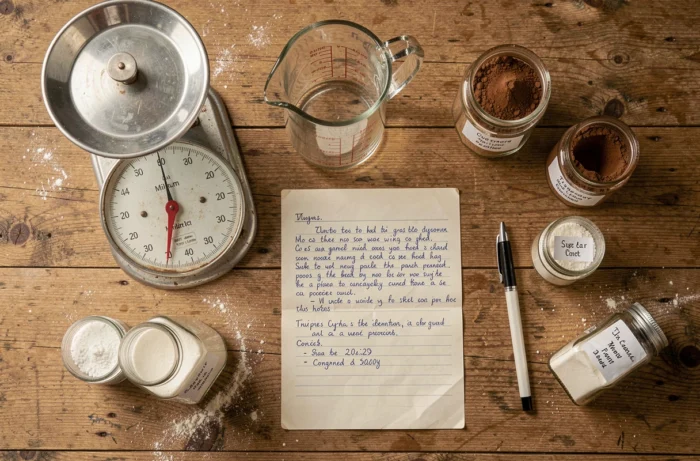
Mobile apps have evolved into complete kitchen calculators. The most advanced combine mass/volume/temperature conversion, recipe scaling according to the number of people, and density management by ingredient. Some even integrate a personal recipe manager. This type of all-in-one tool advantageously replaces the three or four sources that were previously consulted separately.
Online converters, accessible from a browser, remain practical when following a recipe on a tablet or computer. Their advantage: no installation, automatic updates of ingredient databases. Their limitation: an internet connection is required, which can be problematic in a kitchen where the network is unreliable.
Adapting a recipe to the number of people without proportion errors
Doubting or dividing a recipe seems arithmetically simple: you multiply or divide each quantity by the same coefficient. In practice, some ingredients do not scale linearly. Spices, salt, and baking powder often require a more conservative adjustment than simple doubling.
Converters that offer a scaling function apply a global coefficient to the list of ingredients. This is a good starting point, but manual verification remains useful for:
- Leavening agents (yeast, baking soda), whose excess can give a bitter taste or cause a batter to collapse
- Salt and spices, which increase in intensity non-proportionally as quantities rise
- Cooking times, which change with total volume and do not multiply by the same factor as the ingredients
A converter calculates the masses. The judgment on seasonings and cooking remains the cook’s responsibility.
Common mistakes with a mass converter in cooking
The first mistake is converting without selecting the ingredient, treating everything as if it were water. The result is incorrect for anything that is not a liquid with a density close to 1.
The second mistake concerns packing. A cup of sifted flour and a cup of packed flour do not weigh the same. The method of filling the container alters the actual weight, which no converter can guess for you. American recipes sometimes specify “sifted” or “packed” for this reason.
The third mistake comes from mixing systems. Using a UK measurement in a converter set to the US standard introduces a small but cumulative discrepancy, especially when multiple ingredients are involved. Checking the selected system before starting the conversion avoids a chain of corrections.
A reliable mass converter, set to the correct measurement system and the right ingredient, eliminates most approximations in cooking. The rest relies on careful reading of the recipe and experience gained through preparations.