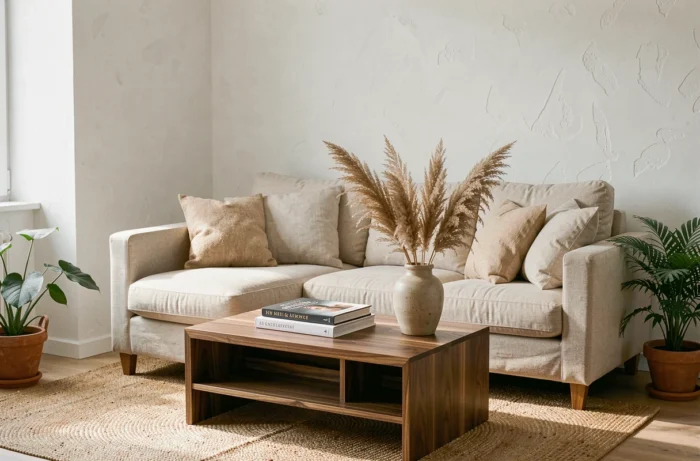
Equipping an interior is no longer just about furnishing empty rooms. Expectations have changed: living spaces must accommodate multiple uses (remote work, meals, relaxation, storage) without sacrificing visual coherence. Catalogs are overflowing with proposals, but the real challenge lies less in aesthetic choice than in a piece of furniture or accessory’s ability to fulfill multiple functions in often constrained spaces.
Modular furniture: the criterion that separates a sustainable purchase from clutter
Recent interiors place a central focus on modularity. Extendable tables, sofas with reconfigurable modules, repositionable shelves: these pieces are no longer niche options. They have become the foundation of a long-lasting layout.
The principle is simple. A piece of furniture that serves only one function in a small space eventually becomes a hindrance. A coffee table with integrated storage, a wall-mounted foldable desk, or a headboard with built-in lighting meet concrete needs without multiplying objects.
Before buying, it’s better to list the actual activities performed in each room. A living room that also serves as an office requires a reconfigurable modular sofa, not a fixed three-meter corner model. Browsing the equipment on Mon Espace Déco allows you to identify ranges designed for this versatility, with filters by use and size.
A well-chosen multifunctional piece replaces two or three separate purchases. It’s a calculation of space as much as budget.
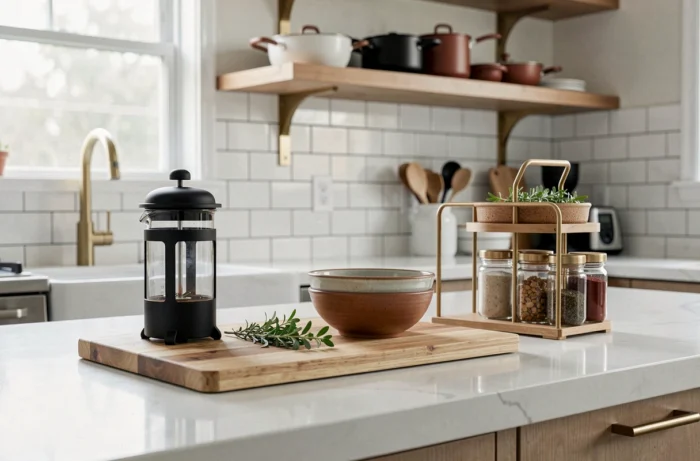
Materials and textures: what warm minimalism changes in equipment choices
Sleek interiors, all in glossy white and uniform surfaces, are losing ground. For several seasons now, trend analyses have described a shift towards what the market calls warm minimalism: clean lines, but combined with tactile and warm materials.
Concretely, this translates into choices of boucle fabric on seating, wood with visible grains on storage, and matte ceramics in kitchens or bathrooms. The goal is not to accumulate textures but to create a sensory contrast between surfaces.
Combining materials without falling into patchwork
A common pitfall is layering too many different textures in one room. An operational rule: limit dominant materials to three per space. For example, light wood, linen, and black metal in a living room. Each additional element dilutes coherence.
Matte finishes are making a strong comeback against glossy ones, including on countertops and faucets. This choice is not purely aesthetic: matte surfaces hide everyday usage marks better, aligning with the practical aspect of equipment.
Interior lighting: layering sources rather than relying solely on the ceiling light
Lighting remains the poor relative of many layouts. A central ceiling light, a bedside lamp, and the subject is closed. This approach creates shadowy areas and a flat ambiance.
A well-lit interior combines at least three levels of light: general lighting (ceiling light or pendant), functional lighting (desk lamp, worktop spotlight), and ambient lighting (string lights, table lamp, indirect LED strip).
- In the kitchen, under-cabinet lighting radically changes preparation comfort, especially in north-facing rooms.
- In the bedroom, an adjustable wall-mounted reading light advantageously replaces the bedside lamp that clutters the nightstand.
- In the living room, a dimmer switch on the main pendant allows you to adjust the ambiance without multiplying fixtures.
Natural light remains the primary lever. Before investing in fixtures, ensuring that nothing obstructs the windows (tall furniture, opaque curtains during the day) often produces a more significant effect than any purchase.
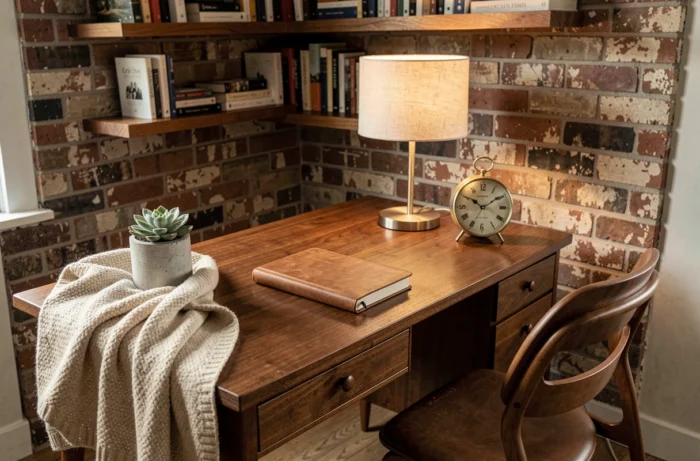
Integrated storage and optimization of the bathroom and kitchen
The bathroom and kitchen concentrate the strongest constraints: humidity, frequent traffic, and the multiplication of small objects. In these two rooms, invisible storage makes the difference between a functional space and a cluttered one.
In the kitchen, drawers with internal compartments, sliding columns, and magnetic backsplashes free up the countertop. Field reports diverge on the actual usefulness of central islands in kitchens smaller than twelve square meters: they add counter space but reduce circulation.
Bathroom: focusing on verticality
Narrow columns, shelves suspended above the toilet, and mirrors with integrated storage exploit height without encroaching on floor space. It’s a simple layout reflex, but still rarely applied in standard bathrooms.
- A wall-mounted vanity frees up the floor and facilitates cleaning while providing closed storage space.
- Labeled baskets or bins inside cabinets prevent the disorganized accumulation of products.
- A hanging bar in the shower replaces the bathtub corner where bottles pile up.
A common mistake is to choose the bathroom furniture last, once the budget has been absorbed by tiles and faucets. Storage should be the first item prioritized, as it conditions daily use far more than the choice of wall covering.
Equipping an interior with style and practicality relies on concrete decisions: prioritize modularity, limit materials to three per room, layer light sources, and treat storage as a structuring priority, not as an afterthought.